
Last updated September 22, 2026
Free on-site gate assessment - hinges, posts, and your LiftMaster or Nice gate operator checked before anything is quoted
The assessment is free and the quote is the invoice.
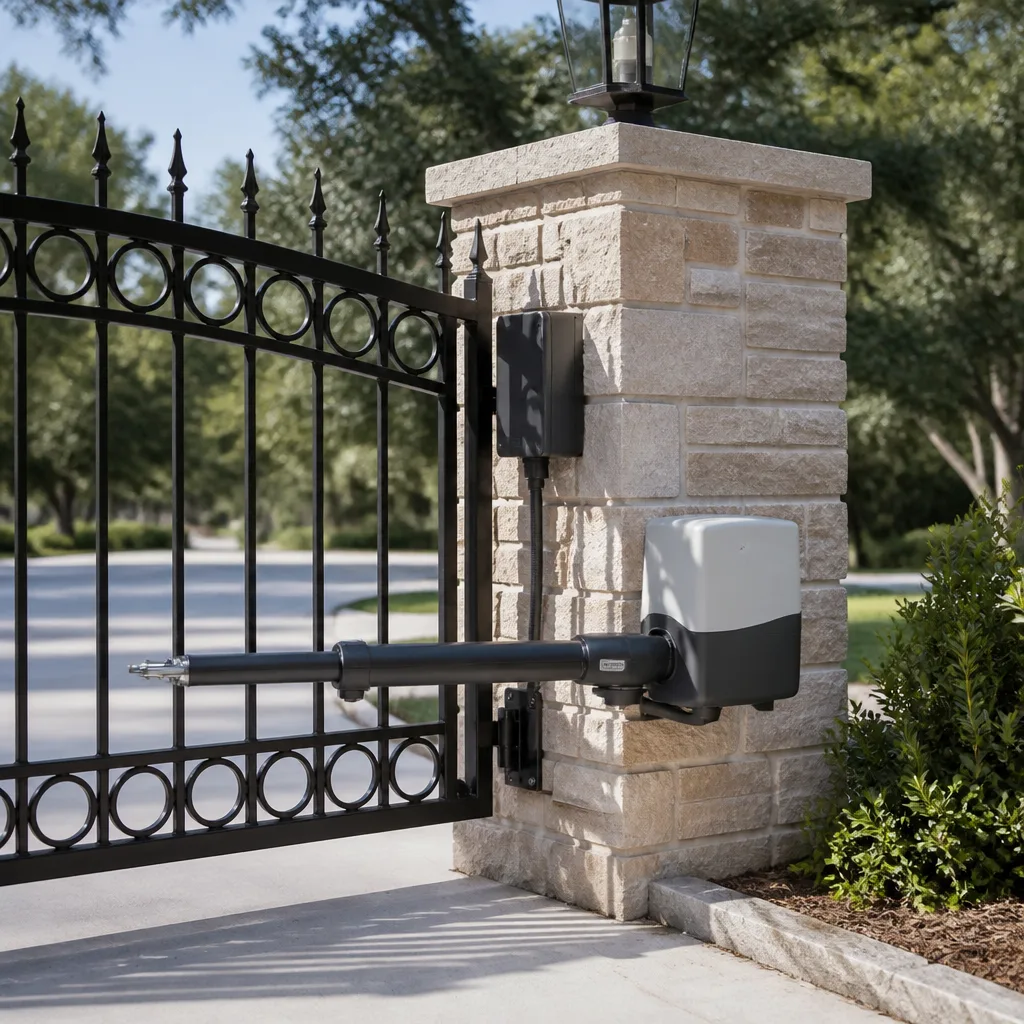
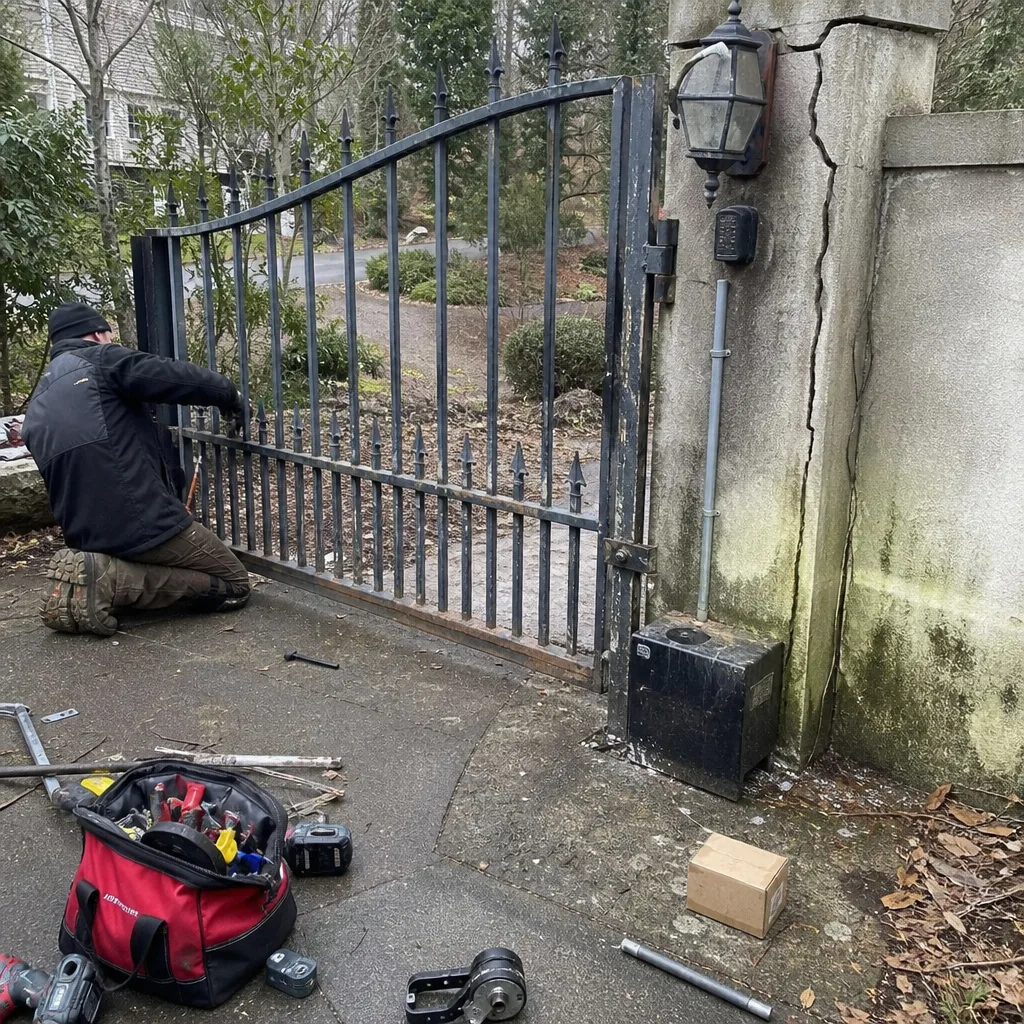 Before
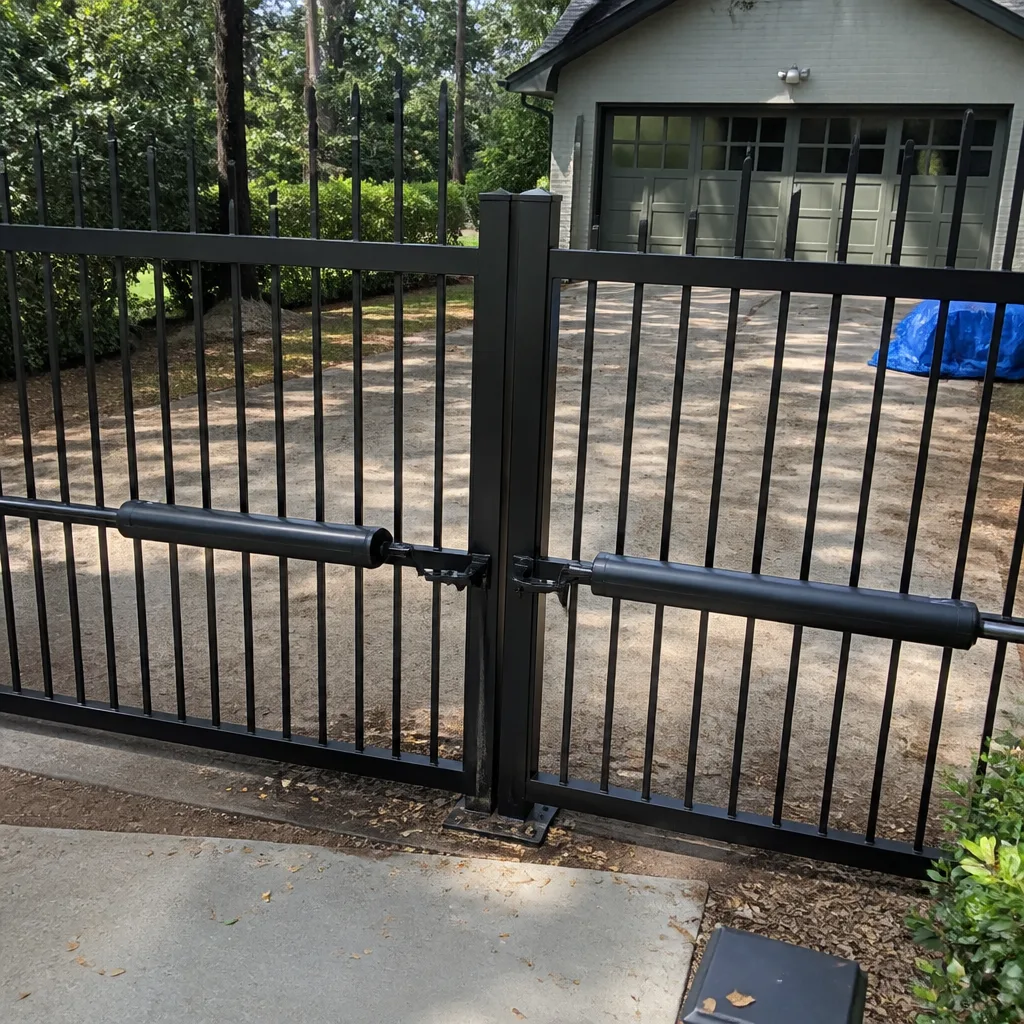 After
After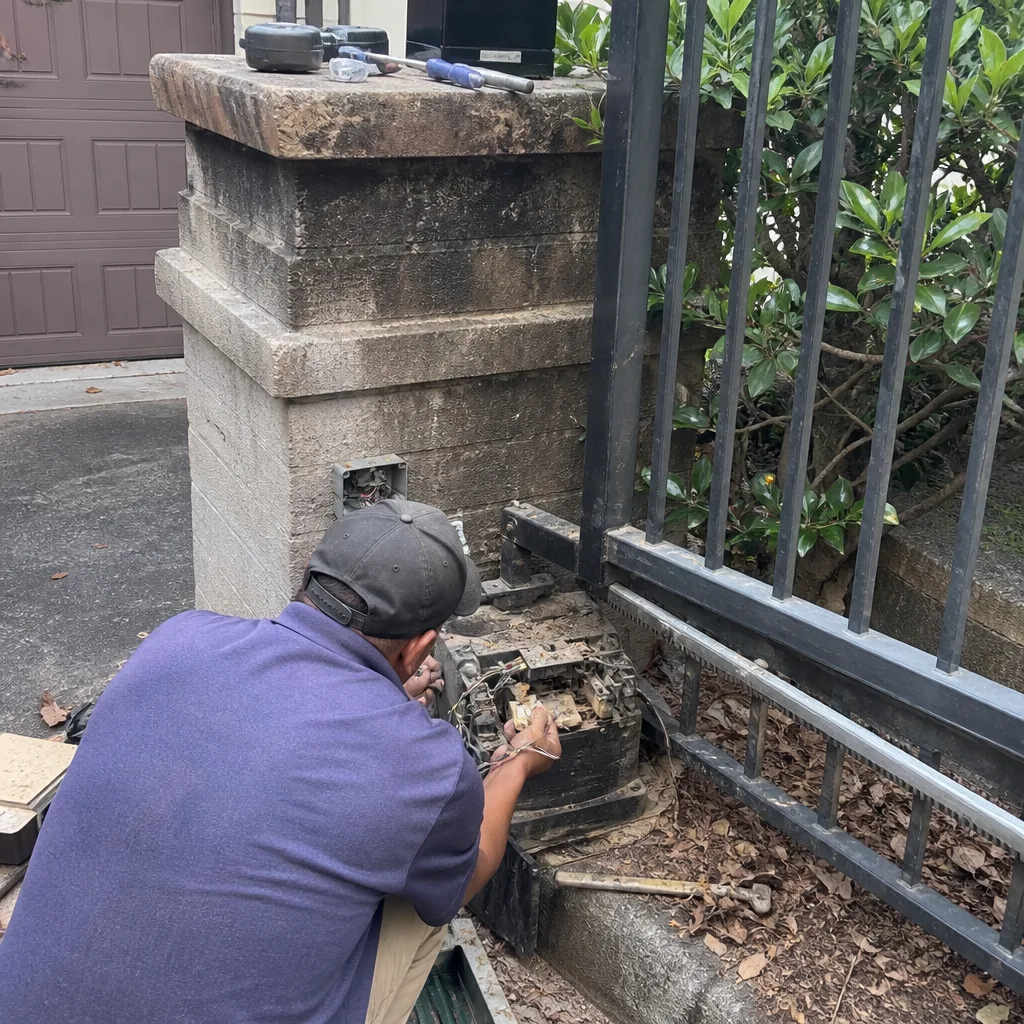 Before
 After
After Before
 After
AfterThe Complete Guide to Gate Repair in Roswell
A gate that “won’t open” can mean eleven different things to a technician, and each one carries a different price tag. The homeowner who can narrow it to “opens on manual release but not on the keypad” cuts their diagnostic time in half, and in Roswell, where many properties sit on clay-heavy soil that shifts with every thunderstorm, that precision matters even more. Most gate failures in this market trace back to one of four documented root causes, and knowing which one you have before calling anyone changes both the repair cost and whether you’re talking to the right company. This guide maps every common gate system component to its failure signature so you can describe the problem precisely, not just symptomatically.
Quick Answer
Gate Repair Cost Breakdown: The Roswell Homeowner’s Reference for 2026 shows that gate repair in Roswell typically costs between $180 and $650 for most common issues, with swing-gate motor replacements running $1,200-$2,400 depending on brand and existing infrastructure. A legitimate repair should include a written price before work starts, a documented photo record of what was found and adjusted, and a labor-and-parts guarantee. In Roswell’s climate, clay soil expansion and seasonal moisture cycles create post-foundation and hinge problems not seen in drier Georgia counties, so local experience with soil-specific failures significantly affects repair durability.
Table of Contents
- The Component-by-Component Failure Map
- How to Tell an Electrical Fault from a Mechanical Fault
- Why Roswell’s Clay Soil Destroys Gate Posts
- Service Call vs. Repair Call: The Difference That Saves Money
- What a Legitimate Repair Record Should Contain
- Brand-Specific Parts and What They Cost in Roswell
- Preventive Maintenance That Actually Works
- Common Mistakes to Avoid
- When to Call a Professional
- Frequently Asked Questions
- The Bottom Line
 Before
 After
AfterThe Component-by-Component Failure Map
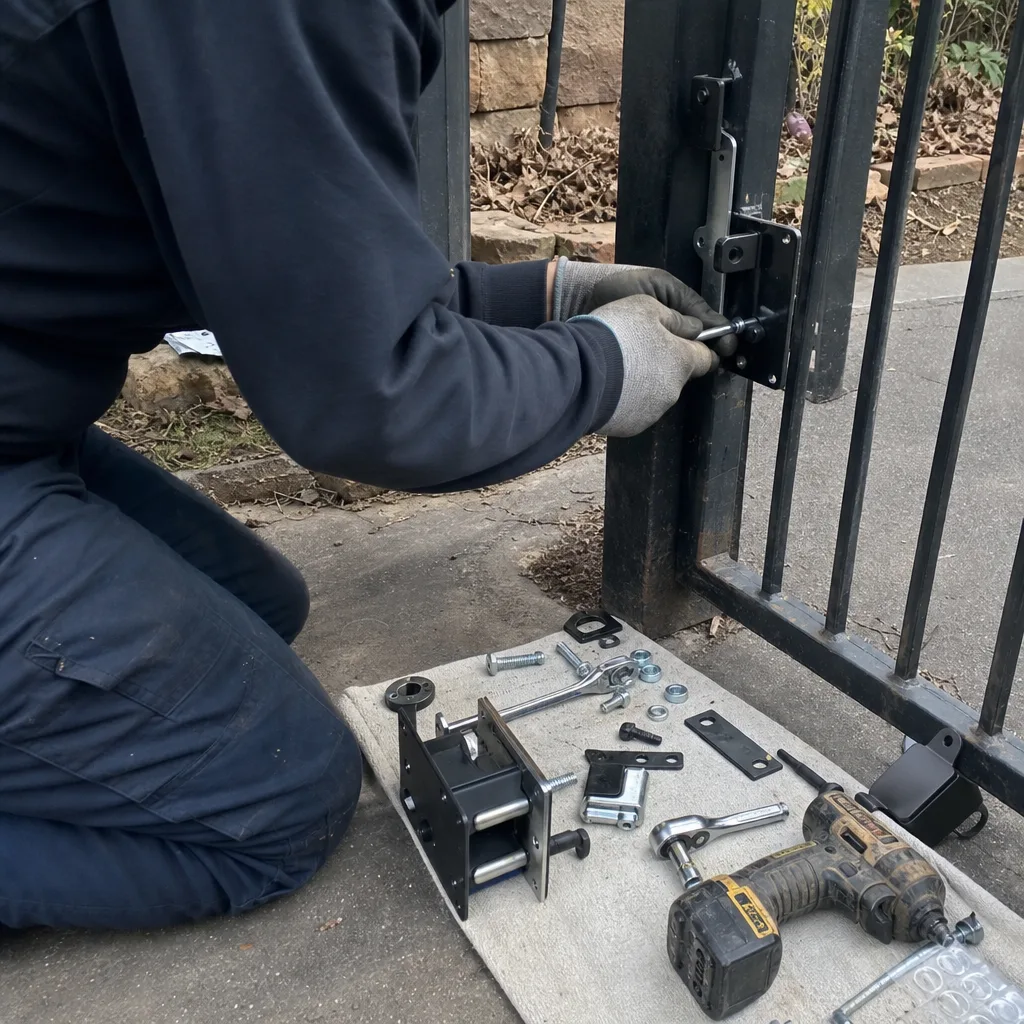
Every gate system has five critical components, and each produces a distinct failure signature. Learning to read these signatures is the single most valuable skill a homeowner can develop before making a call.
1. The Operator (Gate Motor)
The operator is the motorized unit that physically moves the gate. In Roswell, we see operator failures split roughly evenly between electrical and mechanical causes, but the symptoms are different.
Failure signatures:
- Gate hums or clicks but doesn’t move: typically a capacitor failure or stripped internal gear. The motor is receiving power but can’t generate torque.
- Gate moves partially then stops: often a thermal overload in the motor windings, common in summer when operators run hot against increased friction from swollen wooden gates.
- No sound at all, no lights on control box: power supply issue, not operator failure. Check the breaker and the GFCI outlet first.
- Gate opens fine but won’t close: this is usually not the operator. See control board and safety device sections below.
On a gate motor replacement in Roswell, the existing arm bracket condition determines whether you’re looking at a motor-only swap or a full hardware rebuild. A rusted or cracked bracket discovered after work starts turns a $1,200 job into a $1,800 job, which is exactly why we photograph the bracket during our free estimate and include it in the written scope.
2. The Control Board
The control board is the computer that translates your keypad entry, remote signal, or loop detector input into operator commands. It’s also where safety logic lives.
Failure signatures:
- Gate responds to remote but not keypad: likely keypad wiring fault or keypad itself, not the board.
- Gate opens randomly or at scheduled times without input: control board timer or relay fault. We’ve traced this in Roswell’s Crabapple area to lightning-induced voltage spikes that damage the board’s clock circuit.
- Gate reverses immediately on closing, every time: safety loop or photo-eye fault, not board failure. The board is doing exactly what it’s programmed to do.
- Gate works in manual mode but not automatic: control board not sending signal, or not receiving it. Check the transformer output (24V AC typical) before condemning the board.
Control boards for brands like Linear and Viking run $280-$450 installed in the Roswell market, but board failure is often misdiagnosed. In our experience, roughly 30% of “dead boards” are actually transformer failures, loose low-voltage connections, or corroded terminal blocks from moisture intrusion.
3. The Loop Detector
The loop detector senses vehicles via an inductive wire buried under the driveway. It’s invisible to homeowners until it fails, and its failures are often mistaken for operator problems.
Failure signatures:
- Gate won’t open when you drive up, but opens fine with remote: loop detector or buried loop wire fault.
- Gate opens when no vehicle is present, especially after rain: loop wire insulation breach, water intrusion changing the inductive signature.
- Gate closes on a vehicle: this is a safety failure, not a convenience failure. The loop should hold the gate open while the vehicle is present. Detector sensitivity drift or loop wire break are the usual causes.
In Roswell’s older neighborhoods like historic district properties near Canton Street, original loop installations from the 1990s used direct-burial wire without conduit. After twenty-plus years of clay soil expansion and contraction, that wire fatigues. We document loop condition with a megohmmeter reading and photograph the wire route before any repair commitment.
4. The Limit Switch
Limit switches tell the operator when the gate has reached fully open or fully closed position. They’re mechanical or magnetic sensors that require precise positioning.
Failure signatures:
- Gate slams open or closed, no deceleration: limit switch not being reached, so the operator runs to mechanical hard stop.
- Gate stops three inches short of closed: limit switch reached prematurely, or mechanical obstruction.
- Gate reverses direction unexpectedly mid-travel: intermittent limit switch contact, often from vibration loosening the mounting bracket.
On a recent job in Roswell’s Horseshoe Bend area, we found a limit switch set 12 degrees past actual gate travel. The previous technician had adjusted it by ear rather than measuring, and the operator was fighting itself every cycle. We reset it, photographed the new position, and logged the degree measurement in the job record. Under our Vance Gate Repair Roswell home documentation standard, that photo and measurement are now available to any future technician.
5. Hinges, Tracks, and Post Foundation
This is where Roswell’s geography becomes the dominant factor. The clay-heavy soil in Fulton County expands when wet and contracts when dry, creating cyclic loading on gate posts that sandy-soil regions simply don’t experience.
Failure signatures:
- Gate drags on ground in summer, fine in winter: post heave from soil expansion, or post settlement from winter contraction. The gate geometry changes seasonally.
- Squealing or grinding from hinges, visible gap between hinge leaves: hinge wear from misalignment stress. The gate is no longer swinging on its designed axis.
- Visible rust streaks from post base, gate leaning visibly: post foundation failure. The concrete footing has cracked or rotated in the soil.
- Roller gate jumps track or binds at same point every cycle: track deformation from post movement, or accumulated debris in the track channel.
Post foundation repair in Roswell typically runs $800-$1,500 because it requires excavation, concrete work, and gate re-hanging. Hinge replacement alone runs $180-$340. The critical diagnostic question is whether the post is stable. A new hinge on a moving post fails again in six months.
How to Tell an Electrical Fault from a Mechanical Fault
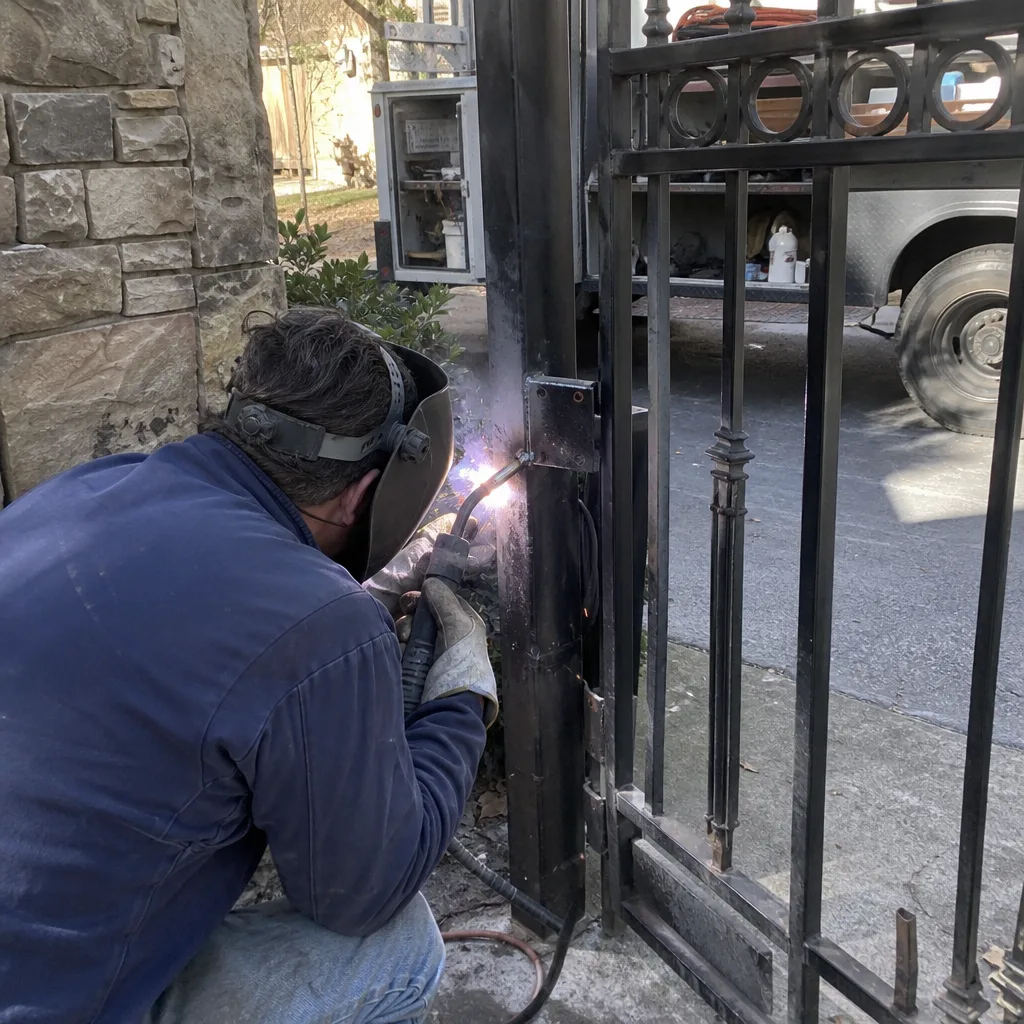
Before calling for Gate Repair, you can narrow the problem category with observations that take two minutes. This distinction matters because electrical faults often travel with the technician who has the right diagnostic tools, while mechanical faults may require welding equipment, concrete work, or specialized parts that not every gate company carries.
The Two-Minute Diagnostic
- Listen at the control box. Is there a transformer hum? LED status light? If the box is completely dark and silent, you’ve got a power supply problem before you have a gate problem. Check your breaker, the GFCI protecting the outlet, and any disconnect switch.
- Try manual release. Every gate operator has a manual release, usually a key-turned lever or pull-cord. If the gate moves freely in manual mode, the mechanical path is clear and the fault is electrical or control-related.
- Listen to the operator during attempted automatic cycle. A healthy operator produces a smooth motor sound with consistent pitch. Grinding, clicking, or labored variation in speed indicates mechanical overload or internal gear damage.
- Check the photo-eye alignment. The infrared beam across the gate path has LED indicators on both sender and receiver. Misalignment, spider webs, or leaf debris interrupt this beam and prevent closing. This is the single most common “failure” we respond to in Roswell, and it requires zero parts.
- Test multiple input methods. Remote, keypad, loop detector, and manual button inside the control box cover. If one works and others don’t, the problem is upstream of the operator, in the specific input device or its wiring.
Electrical faults typically present as: no response, intermittent response, or correct response to wrong stimulus. Mechanical faults present as: abnormal sound, visible resistance, or position-dependent behavior. The distinction isn’t always clean, a binding hinge can overload a motor and trip thermal protection, but starting with this framework prevents misdiagnosis.
In our work across Roswell, from the large estates along Azalea Drive to the gated townhome communities near Holcomb Bridge Road, we’ve found that homeowners who can report “manual release works, automatic doesn’t, and there’s no hum from the box” get accurate phone estimates 80% of the time. Those who report “it just stopped working” require on-site diagnosis.
Why Roswell’s Clay Soil Destroys Gate Posts
Most gate repair guides ignore soil entirely. That’s a costly omission in Roswell, where the Georgia red clay that makes this area’s topography distinctive also makes it one of the more challenging environments for gate longevity in the metro Atlanta region.
The technical issue is expansive clay soil, specifically the Cecil soil series common in North Fulton County. This soil can change volume by 10% or more between saturated and dry conditions. A concrete post footing embedded in this soil experiences cyclic uplift and settlement forces that sandy or loamy soils don’t produce. Over five to ten years, this movement fatigues the concrete, loosens the post-to-footing connection, and transfers misalignment stress to hinges, operators, and track systems.
What this looks like in practice:
- Gates that worked fine for years develop seasonal dragging patterns, worse in late summer after dry spells or in spring after heavy rains.
- Post bases show fresh concrete cracking or separation from the original footing.
- Hinge bolts loosen repeatedly despite proper torque, because the post is moving.
- Automatic operators strain or fault more frequently as gate geometry shifts out of specification.
The repair implication is significant. A technician who replaces your operator without checking post stability has addressed a symptom, not a cause. In Roswell, we check post plumb with a digital level and photograph the footing condition as standard practice. If the post moves more than 2 degrees from vertical or shows footing distress, we flag it in the written scope before any operator work proceeds.
For new installations, we spec deeper footings with wider bases than the minimum code requires, and we use concrete mixes with lower water content to reduce shrinkage cracking. These aren’t upgrades we charge extra for, they’re standard practice for clay-soil conditions. A new gate installation in Roswell that ignores soil mechanics fails prematurely regardless of material quality.
Service Call vs. Repair Call: The Difference That Saves Money
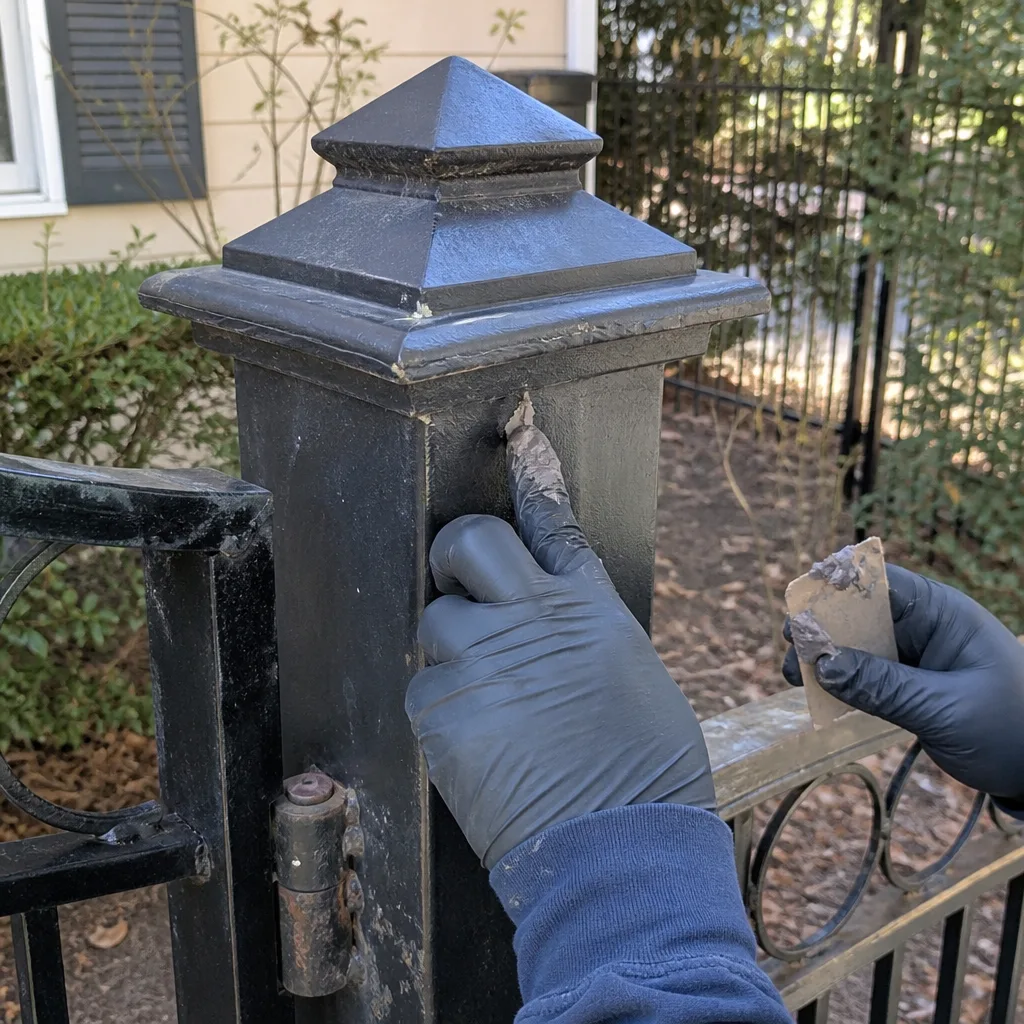
This distinction is poorly understood and frequently exploited. A service call is scheduled maintenance, inspection, and adjustment. A repair call addresses a specific failure. Conflating them leads to repeat billing and incomplete work.
A proper service call includes:
- Operator force and sensitivity testing per manufacturer specification
- Limit switch position verification and adjustment
- Safety device function test (photo-eye, edge sensor, loop detector)
- Hinge lubrication and wear inspection
- Control board firmware check and backup battery test
- Documentation of all readings and adjustments
A repair call addresses:
- A reported failure or malfunction
- Replacement of failed components
- Restoration of normal function
The problem arises when a company dispatches for a repair, replaces the obvious failed part, and leaves without inspecting the rest of the system. The homeowner pays for a repair, gets temporary function, and faces another failure in months because the underlying maintenance was never done. Or conversely, a company sells a “tune-up” service call at repair prices without addressing the actual failure.
At Vance Gate Repair, we separate these explicitly. If you call with a failure, we quote a diagnostic and repair. If we find that your system also needs scheduled service, we quote that separately and you choose. Under The Haven Standard, both get written scopes with distinct prices before any work starts. We’ve seen competitors in the Roswell market bundle a $180 hinge adjustment into a $650 “complete service” that the homeowner didn’t request.
The documentation difference matters too. A service call should leave you with a record of baseline measurements, force settings in pounds, limit positions in degrees, and safety device response times. A repair call should leave you with part numbers, warranty terms, and before/after photos. A verbal summary of either is worthless the next time something fails.
What a Legitimate Repair Record Should Contain
A repair record isn’t paperwork for its own sake. It’s the foundation of future diagnostic efficiency and the proof that work was actually performed to specification. After 22,000 documented jobs since 2014, we’ve established what a record must include to be useful.
Every legitimate gate repair record contains:
- Written scope of work. What was found, what was done, what was replaced. Not “fixed gate” or “repaired operator.” Specific: “Replaced Linear LDO50 operator, reset limit switches at 87° open and 0° closed, tested safety reverse at 15 lb force.”
- Part numbers and serial numbers. The actual manufacturer part number installed, not “new motor” or “compatible board.” This determines warranty eligibility and future parts availability.
- Photographic evidence. What the technician found, what was adjusted, what was installed. Date-stamped, geotagged, and provided to the homeowner. Under Haven Standard Clause 4, this is non-negotiable on every visit.
- Measured parameters. Force test results, limit positions, voltage readings, loop detector sensitivity settings. These establish baseline for future comparison.
- Warranty terms in writing. What is covered, for how long, and what conditions void coverage. Our 365-Day Done Right Promise covers all completed work with no expiration within that window, but the terms are written, not implied.
A verbal work summary, a handwritten ticket with no part numbers, or a invoice that says “labor and materials” without specification, these are warning signs. They mean the next technician starts from zero, and you may pay twice to rediscover the same problem. We’ve taken calls in Roswell where a homeowner has three years of “service” from another company and zero documentation of what was ever done.
The photo record is particularly critical for gate systems because so much is invisible. A wiring diagram sketched by the installing technician and photographed for the record saves hours on future service. A photo of the post footing condition at installation establishes baseline for soil-movement assessment. These aren’t extras. They’re the difference between efficient repair and expensive guessing.
Brand-Specific Parts and What They Cost in Roswell
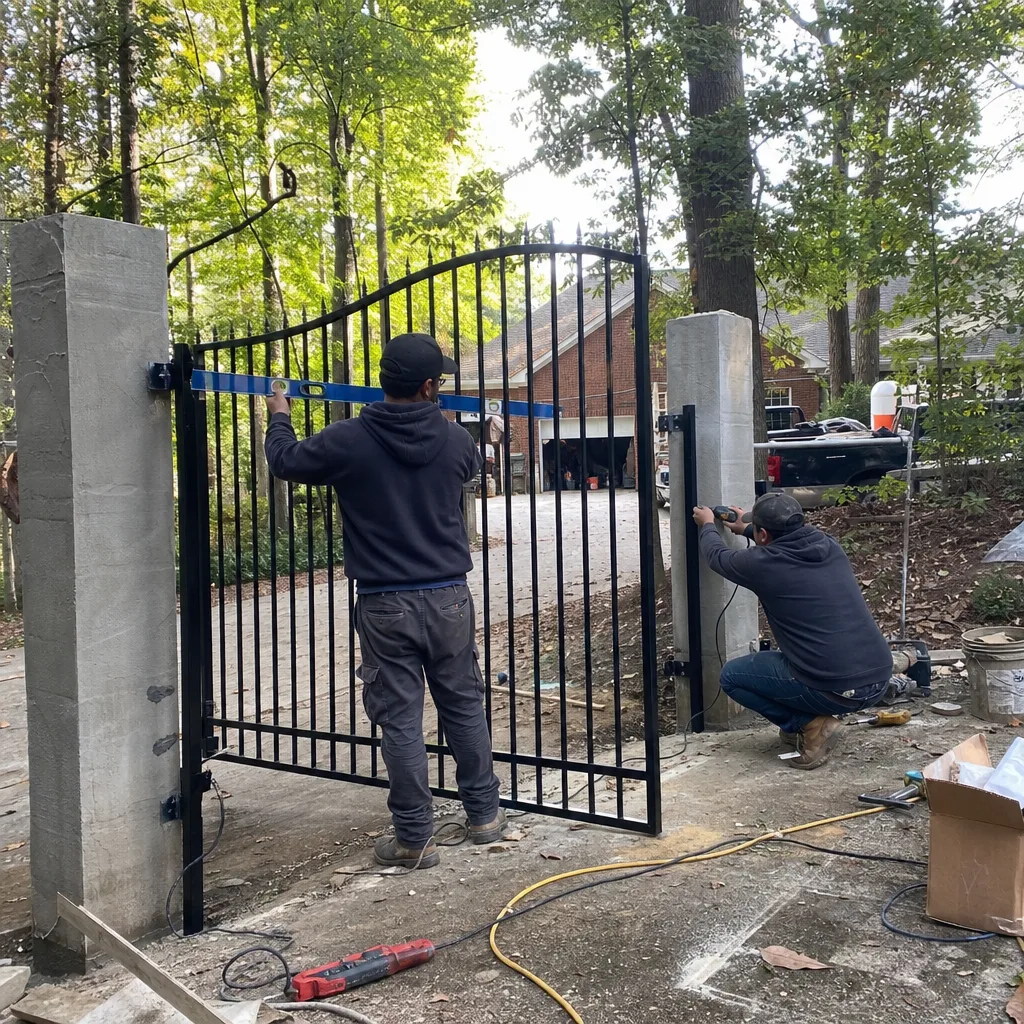
Gate automation is not a commodity market. Nine major brands dominate residential and light commercial installations, and parts are not interchangeable. A technician who carries only one brand’s inventory will steer you toward replacement rather than repair if your system is different.
We service nine brands, LiftMaster, FAAC, BFT, Linear, Viking, Ghost Controls, DoorKing, Elite, and Mighty Mule, and stock common failure parts for all nine. This matters because the brand on your property should not determine whether it can be repaired.
Roswell market pricing for common repairs by brand category:
| Component | Entry-Level Brands (Mighty Mule, Ghost Controls) | Mid-Range Brands (Linear, Viking) | Commercial-Grade Brands (FAAC, BFT, DoorKing) |
|---|---|---|---|
| Control board replacement | $240-$340 | $280-$420 | $380-$550 |
| Operator arm/gear repair | $180-$280 | $220-$340 | $280-$450 |
| Limit switch assembly | $140-$200 | $160-$240 | $200-$320 |
| Photo-eye pair | $120-$180 | $140-$200 | $180-$260 |
| Loop detector replacement | $200-$280 | $220-$300 | $260-$380 |
Note: Prices include diagnostic, parts, and labor. Full motor replacement runs higher and varies significantly by gate weight, cycle frequency, and existing infrastructure condition.
The BFT and Linear systems we see frequently in Roswell’s newer construction tend toward control board and sensor failures rather than mechanical wear, these brands design for electronic sophistication over brute durability. Viking systems, common in heavier residential and light commercial gates, show more mechanical wear patterns but longer overall lifespan. Ghost Controls, popular for DIY installations, often come to us with installation errors that mimic part failure: undersized wire, inadequate grounding, or improper limit setting.
The key point: a company that quotes replacement without identifying your brand and model is not doing diagnostic work. They’re selling. We identify the system during our initial call, confirm it with a photo from the homeowner if needed, and arrive with relevant parts and documentation.
Preventive Maintenance That Actually Works
Most DIY vs Professional Gate Repair: The Roswell Homeowner’s Decision Guide advice is generic and ineffective. “Lubricate the hinges” is correct but incomplete. “Check the batteries” is obvious. Here’s what actually extends gate life in Roswell’s specific conditions.
Seasonal maintenance schedule:
- Spring (March-April): Inspect post footing for new cracking after winter soil contraction. Check hinge bolt torque, soil movement loosens hardware. Test safety reverse function after winter debris accumulation. Photo-document condition for year-over-year comparison.
- Summer (June-August): Monitor operator thermal performance during peak heat. Clean photo-eye lenses of pollen and dust, Roswell’s oak and pine pollen season extends into early summer. Check control box ventilation, heat is the primary killer of electronic components.
- Fall (October-November): Clear track channels of fallen leaves before they compact into organic sludge. Inspect loop detector response after summer thunderstorm season, water intrusion faults often manifest in fall as soil dries and cracks shift buried wire.
- Winter (December-February): Test manual release mechanism, cold weather makes neglected releases stiff. Verify heater or cold-weather package function on operators so equipped. Check for ice formation in track or hinge points after freeze events.
The one maintenance action with highest return: Keep a written log of gate behavior, including dates of any anomaly, weather conditions, and what resolved it. This history is more valuable to a technician than any single inspection. “Sticks in humid weather, fine when dry” tells us more than a month of our own testing.
We offer scheduled maintenance in Roswell with full documentation under Haven Standard Clause 4, but the homeowner who maintains their own log and performs basic visual inspection gets 80% of the benefit at zero cost. See our more guides & resources for additional homeowner maintenance tips. The remaining 20% requires calibrated tools and trained observation that we provide.
Common Mistakes to Avoid
- Calling an electrician for a gate problem. Licensed electricians understand power supply. Most do not understand limit switches, loop detectors, or operator force settings. You need a gate specialist for gate control issues, and an electrician for the 240V feed to the operator location.
- Accepting a verbal estimate. In Roswell’s competitive market, some companies lowball verbally and invoice higher after “discovering” additional issues. A written price before work starts, with scope definition, is the only protection. Haven Standard Clause 1 exists specifically because this practice is common.
- Ignoring seasonal patterns. A gate that fails every August isn’t randomly breaking. It’s telling you about heat, soil, or load conditions that a competent technician can identify and address. Treating repeated seasonal failures as unrelated incidents wastes money.
- DIY operator replacement without understanding force settings. Gate operators are motorized equipment that can crush or entrap. UL 325 safety standards require specific force limits and safety device integration. Self-installed operators without proper safety configuration create liability and injury risk. We document force test results on every installation.
- Neglecting the manual release. Every gate operator has one, and it’s your exit path during power failure or system fault. If you don’t know where it is or haven’t tested it in six months, you’re unprepared for the emergency that will eventually occur.
- Assuming all gate companies service all brands. Many Roswell-area companies carry parts for only one or two brands. If your system is different, they may recommend unnecessary replacement. Verify brand capability before scheduling.
When to Call a Professional
Call a gate repair professional when: the gate fails to respond to any input method, makes abnormal sounds during operation, reverses unexpectedly or fails to reverse on contact, shows visible post or foundation movement, or has not had documented professional service in over two years. These conditions indicate either active failure or accumulated risk that inspection should address.
Do not attempt repair yourself if the problem involves high-voltage electrical supply, welded structural components, or operator force settings. These carry genuine injury risk and liability exposure.
Gate Repair in Roswell from Vance Gate Repair includes free estimates with written scope and price before any work begins. We answer calls live 24 hours a day, seven days a week, no voicemail loop or callback queue. For a free estimate in Roswell, call (706) 928-9815.
Frequently Asked Questions
Most common gate repairs in Roswell run $180-$650, including diagnostic, parts, and labor. Hinge adjustments and sensor realignments sit at the lower end, control board replacements and post foundation work at the higher end. Full swing-gate motor replacement typically runs $1,200-$2,400 depending on brand and whether existing arm brackets and hardware are reusable. We provide a written price before any work starts, and estimates are free. Call (706) 928-9815 for exact pricing on your specific system.
Many gate motors can be repaired rather than replaced. Capacitor failures, gear stripping, and limit switch faults are typically repairable at 30-50% of replacement cost. Motors with flooded housings, seized bearings, or obsolete control integration usually require replacement. We diagnose before quoting and stock repair parts for nine major brands including Linear and Viking. The decision is always yours with a written price for each option.
This pattern strongly indicates clay soil expansion affecting post position or wood gate panel swelling. Roswell’s Cecil soil series expands significantly when saturated, then contracts during dry periods. The gate geometry changes seasonally, creating binding that disappears in cooler, drier months. Post stabilization or hinge adjustment with seasonal clearance can resolve this. We check post plumb and soil conditions during every estimate.
A service call is scheduled maintenance: inspection, adjustment, lubrication, and testing. A repair call addresses a specific failure. Some companies blur this to sell unnecessary services or skip needed maintenance. We separate them with distinct written scopes and prices. You choose what proceeds.
We service the complete system: operators, control boards, safety devices, loop detectors, keypads, card readers, and telephone entry systems. Our background in commercial access control from 2014 forward means we understand integration between physical gate operation and electronic access management. A keypad that works intermittently may indicate wiring fault, power supply issue, or control board communication error, we diagnose across the full stack.
You should receive: a written scope of work with specific part numbers installed, date-stamped photographs of what was found and what was done, measured parameters like force settings and limit positions, and warranty terms in writing. Under Haven Standard Clause 4, every Vance Gate Repair visit includes this documentation at no additional charge. Verbal summaries or invoices reading “labor and materials” provide no future diagnostic value.
The Bottom Line
Gate repair in Roswell is not mysterious, but it is specific. The clay soil, the thunderstorm cycles, the mix of historic and new construction, these create failure patterns that generic advice misses. The homeowner who can distinguish electrical from mechanical faults, who understands that “won’t open” describes eleven different conditions, and who demands written documentation on every visit, this homeowner gets accurate diagnosis, fair pricing, and repairs that last.
The four root causes cover most failures: operator wear, control logic faults, safety device interruption, and soil-induced mechanical stress. Map your symptoms to these categories before calling anyone. Ask for written scope and price before authorizing work. And keep your documentation, because the next technician’s efficiency depends on the last one’s record.
For a free estimate with written price before any work begins, call Vance Gate Repair Roswell at (706) 928-9815. We answer live 24/7.
Written by Adrian Vance, Owner at Vance Gate Repair Roswell, serving Roswell since 2014.