
Last updated September 22, 2026
Free on-site gate assessment - hinges, posts, and your LiftMaster or Nice gate operator checked before anything is quoted
The assessment is free and the quote is the invoice.
 Before
 After
After Before
 After
After Before
 After
AfterSeasonal Gate Repair Care for Roswell: Year-Round Homeowner’s Guide
The gate that fails in January in Roswell usually started failing in October. When nighttime temperatures first dropped into the 40s, contracting metal began shifting limit switch positions by fractions of an inch. Those fractions compound over weeks until the operator cannot complete a full cycle. We see this pattern every winter at Vance Gate Repair Roswell, and the homeowners who scheduled a fall inspection are rarely the ones calling for emergency service in January. This guide breaks down what each season actually does to your gate in Roswell’s specific climate, what to check yourself, and what belongs in a technician’s hands.
Quick Answer
Roswell gate owners should perform four distinct seasonal checks: summer capacitor and board inspections for heat damage, fall photo-eye cleaning and realignment before pollen season ends, winter post-footing assessments after freeze-thaw cycles, and spring weld-point rust inspections after humid months. Document each check with dated photos so year-over-year comparison reveals progressive problems before they become emergency repairs.
Table of Contents
- What Roswell Summer Heat Does to Gate Operators
- Fall Pollen and Photo-Cell Failures in Roswell
- Winter Freeze-Thaw and Post Footing Damage
- Spring Rust Inspection: Five Weld Points to Check
- How to Document Seasonal Checks for Trend Detection
- A Practical Roswell Maintenance Calendar
- Common Mistakes to Avoid
- When to Call a Professional
- Frequently Asked Questions
 Before
 After
AfterWhat Roswell Summer Heat Does to Gate Operators
Roswell averages 35 days above 90°F each year, with July and August pushing past 95°F regularly. That heat does not just make your gate sluggish. It degrades specific components in predictable ways that a simple temperature check can predict.
The capacitor problem. Every gate operator contains a start capacitor, a cylindrical component that stores the electrical charge needed to overcome initial motor resistance. Capacitors contain an electrolyte that degrades faster at sustained high temperatures. In Roswell’s July heat, a capacitor already at 80% capacity can fail entirely within a single week of 95°F days. The symptom is a motor that hums but does not turn, or a gate that starts opening then stops midway.
Here is the inexpensive check that predicts failure before it happens: with the operator powered down, discharge the capacitor safely (a trained technician does this with an insulated screwdriver across the terminals), then test capacitance with a multimeter set to the appropriate microfarad range. A reading below 80% of the rated value means replacement is imminent. We document this reading on every summer service call at Gate Repair in Roswell, and homeowners who keep those records can spot the downward trend across seasons.
Control board thermal damage. The printed circuit board inside your operator sits in a metal enclosure that amplifies heat. Solder joints expand and contract with temperature cycling; after enough Roswell summers, microfractures develop. The failure mode is intermittent: the gate works fine at 8 AM, fails at 3 PM, works again at 7 PM. This pattern confuses homeowners because the gate is not “broken” in any consistent way.
We look for three signs of board distress during summer inspections:
- Discolored solder joints around relay connections
- Capacitor bulging or vented electrolyte on the board itself
- Thermal grease dried to powder on any heat-sinked components
Operators from LiftMaster and FAAC that we service in Roswell’s older neighborhoods, particularly near Historic Roswell, often show this pattern in their tenth summer. The board may not need immediate replacement, but knowing its condition lets you schedule replacement before a failure strands your vehicle. For a deeper look at seasonal care, see our The Complete Guide to Gate Repair in Roswell.
What homeowners can do: keep vegetation trimmed back at least 18 inches from the operator enclosure for airflow, and check that any factory-installed ventilation slots are not clogged with spider webs or leaf debris. What requires a technician: capacitor testing, board inspection, and any work inside the operator enclosure where 120V or higher is present.
Fall Pollen and Photo-Cell Failures in Roswell
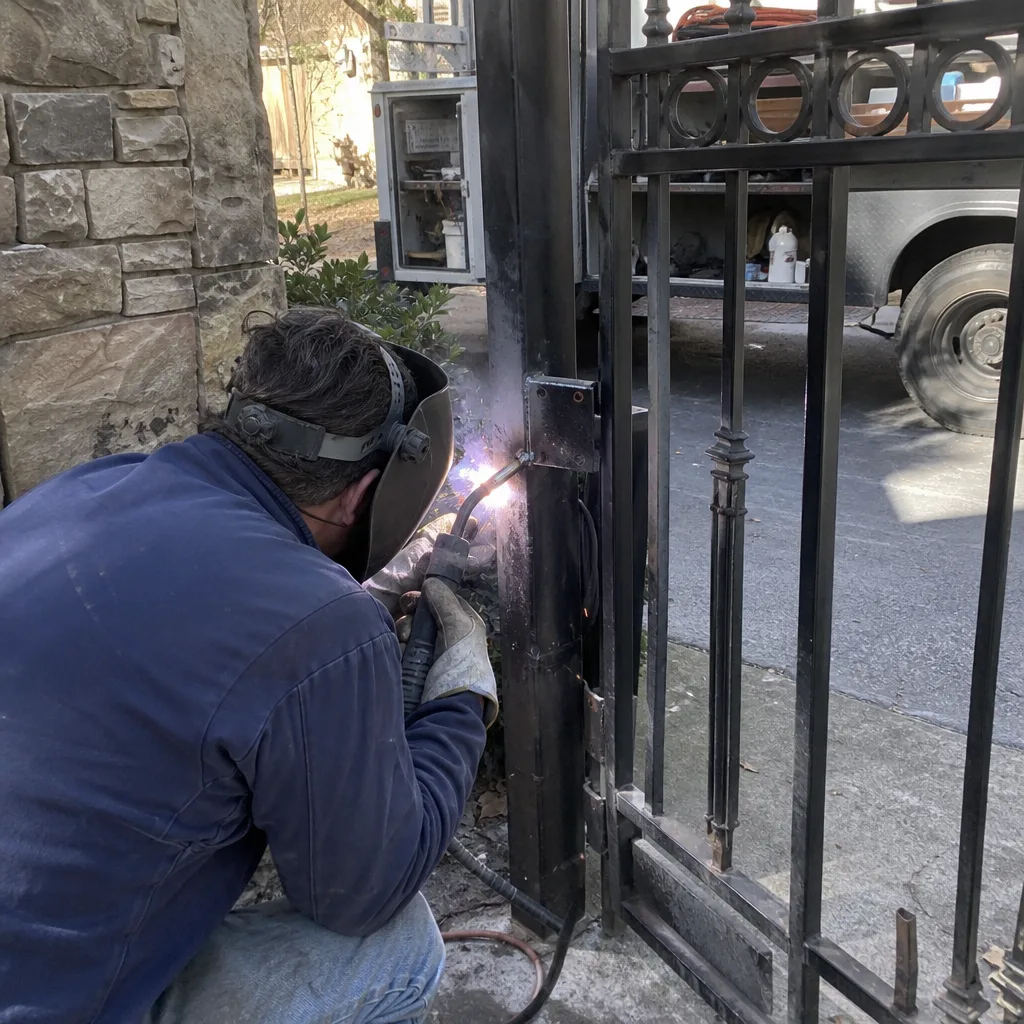
Fall is the highest-risk season for photo-cell faults in Roswell, and most homeowners never connect the two. Pine pollen peaks in spring, but oak, ragweed, and grass pollens run from August through October. That pollen settles on the infrared transmitter and receiver lenses of your gate’s photo-eye system, the pair of small boxes that face each other across the gate path and stop the gate if the beam breaks.
A photo-eye with a dirty lens does not fail completely at first. It fails marginally: the beam signal weakens, and the operator interprets this as an obstruction. The gate begins reversing randomly, or stops and beeps three times (a common diagnostic pattern on Linear and BFT operators we service). Homeowners often blame the motor or the remote when the problem is optical.
Cleaning without introducing new misalignment. This is where most DIY attempts make the problem worse. The photo-eye brackets are designed to move. A homeowner wipes the lens, bumps the bracket by a degree or two, and now the beam misses the receiver entirely. The gate will not close at all.
- Power down the operator at the disconnect switch before touching any component.
- Use a microfiber cloth dampened with water only; solvents can cloud the plastic lens.
- Clean both the transmitter and receiver, even if only one looks dirty. Pollen is often invisible on the infrared-transparent surface.
- Check the LED indicators on both units before and after cleaning. Most photo-eyes show a solid green or red when aligned and receiving. Note the color in your documentation.
- If either LED flickers, loosen the bracket mounting bolt only enough to pivot, adjust in small increments, and tighten without shifting position. A second person watching the LED helps enormously.
- Test the full gate cycle three times, including stopping and reversing, before considering the job done.
In Roswell’s wooded lots, particularly east of GA-400 where mature oak canopy is dense, we see photo-eye misalignment every October that traces back to August pollen accumulation followed by a September cleaning attempt. Under The Haven Standard, we photograph the LED status and the bracket position before we leave, so any future technician knows the baseline.
The commercial-grade documentation habit. When we clean and realign photo-eyes on a fall service call, we record the make and model of the photo-eye set, the measured beam height above grade, and the bracket angle relative to the gate path. This takes three minutes and prevents the next technician from rediscovering the same parameters. Homeowners can adopt a simpler version: a dated photo of the LED colors and a note of the gate’s behavior after cleaning.
Winter Freeze-Thaw and Post Footing Damage
North Atlanta’s clay-heavy soil creates a freeze-thaw problem unique to this region, and Roswell sits squarely in it. The Piedmont clay expands when wet and contracts when dry, and winter temperature swings, often 30°F in a single January day, accelerate the cycle. Your gate posts sit in concrete footings embedded in this unstable medium.
How post movement begins. Water infiltrates the soil around the footing. A hard freeze expands that water by 9%, pushing the footing upward or tilting it. The thaw leaves voids. Over successive cycles, the footing settles unevenly. The post tilts. The gate leaf, hung from that post, no longer swings in a true arc. The operator arm or chain must work harder. Eventually something breaks: the arm bracket, the chain, or the operator itself.
The critical insight: this damage is visible before it becomes structural. Here is what to check on your Roswell gate each January, after the first sustained cold period:
- Post plumb: Hold a level against the post face. Any tilt visible to the eye is too much. We consider 1/4 inch out of plumb over 6 feet the threshold for intervention.
- Gate gap consistency: The gap between gate and latch post should be uniform top to bottom. If the gap narrows at the top, the hinge post is tilting inward. If it widens, the post is tilting outward or settling.
- Operator arm angle: On swing gates, the arm should push or pull squarely. If the arm binds at either end of travel, post movement has changed the geometry.
- Concrete collar integrity: Look for cracks radiating from the footing, or a gap between the post and the concrete surface. Either indicates soil movement.
We repaired a gate last February in the Martin’s Landing area where the hinge post had tilted 3 degrees over three winters. The homeowner noticed only that the gate “sounded different.” The operator arm bracket had cracked from the strain. Caught after the first winter, the post could have been stabilized with a footing extension. After three winters, the entire post and footing required replacement, plus a new operator arm bracket, plus recalibration of the limit switches. The documented photo record from our prior visit, two years earlier, showed the post plumb at that time. The trend was unmistakable in hindsight.
Prevention in Roswell’s specific conditions: Ensure drainage slopes away from gate footings. In flat yards common near the Chattahoochee River floodplain, this may require a French drain or at minimum a gravel apron. Do not pile mulch or leaf debris against post bases; it holds moisture against the concrete collar.
Spring Rust Inspection: Five Weld Points to Check
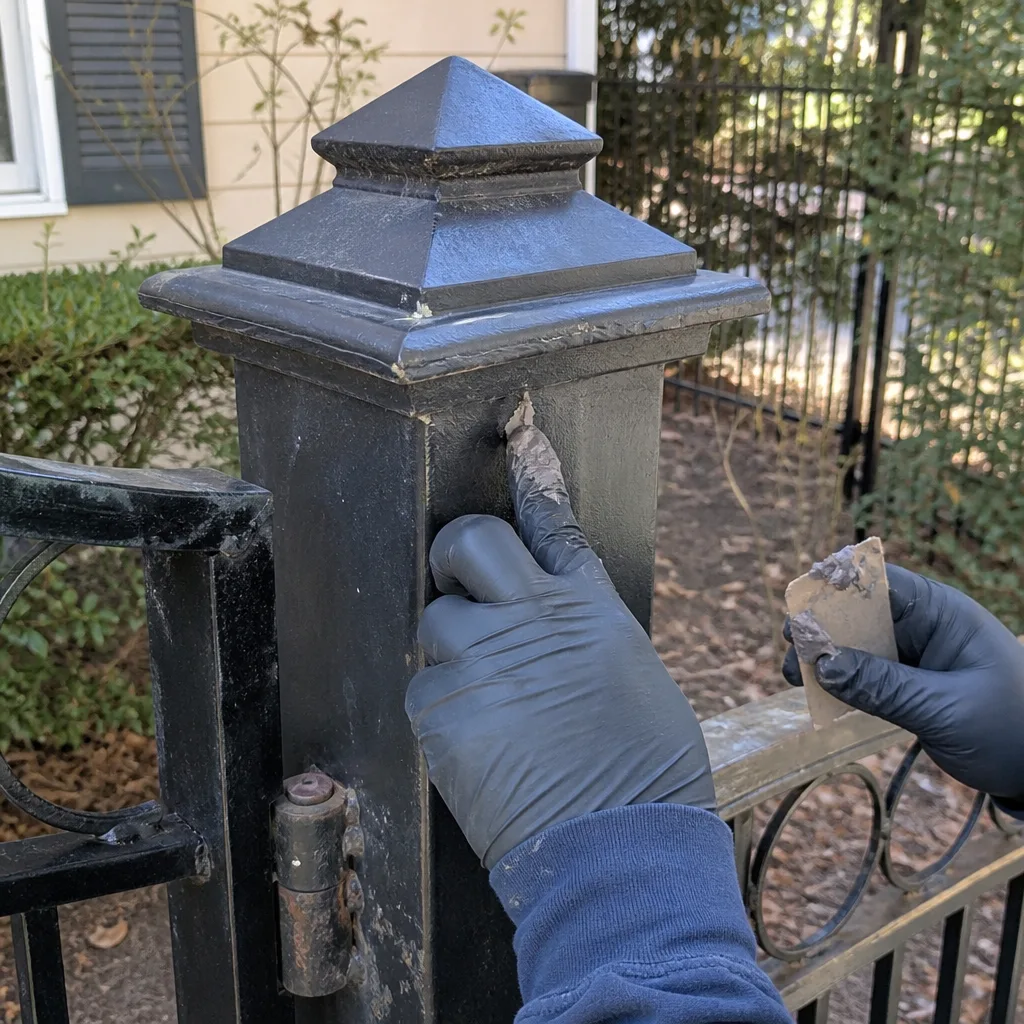
Spring in Roswell brings 4 to 5 inches of rain across March, April, and May, with humidity regularly above 75%. For wrought iron and steel gates, this is the season when rust accelerates at locations that stayed dry all winter. The damage is not cosmetic. Rust at weld points weakens the joint itself and can propagate into the parent metal, turning a repairable spot into a gate replacement.
We inspect these five weld points first on every spring service call in Roswell:
- Hinge barrel to frame: The vertical barrel that receives the hinge pin is welded to the gate frame at top and bottom. Water collects in the barrel, and the weld at the lower end is perpetually damp. Rust here is often hidden by the hinge pin itself. We remove the pin, inspect, and if surface rust is present, clean with a wire wheel and apply a weldable primer.
- Pickets to top rail: The horizontal top rail of a wrought iron gate is a collection point for moisture from both above (rain) and below (rising humidity from the soil). Each picket weld is a potential failure point. We look for rust “bleeding” down the picket from the weld, which indicates active corrosion.
- Frame corner gussets: The diagonal or triangular gusset plates that stiffen gate frame corners are often welded on both sides but left open at the edge. Moisture enters the gap and rusts from the inside out. By the time rust shows on the face, the interior may be half gone.
- Operator arm bracket to gate: This bracket takes dynamic load every cycle. Any rust at the weld reduces fatigue resistance. We have replaced brackets in Roswell where rust-pitting created a stress riser that cracked the bracket in normal use.
- Post cap welds: Decorative post caps are often welded at four corners. The cap traps water against the post top, and the welds are the first point of attack. A rusted-through cap weld lets water into the hollow post, accelerating interior corrosion.
What the inspection reveals. Surface rust, defined as discoloration without pitting, can be addressed with mechanical cleaning and protective coating. Pitted rust, where the metal surface is visibly eroded, requires welding repair or component replacement. We photograph each weld point and classify it in our job record: clean, surface rust, or pitted. Over years, this creates a degradation timeline that predicts when replacement makes more sense than repeated repair.
For homeowners in Roswell’s older neighborhoods with original wrought iron gates, particularly near the historic district, spring is also the time to check whether previous repairs, often done by handymen without welding equipment, have held. We frequently find cold-soldered or brazed joints that looked fine in dry weather but failed under spring humidity load.
How to Document Seasonal Checks for Trend Detection
A single inspection is a snapshot. Four inspections per year, maintained for three years, become a diagnostic tool. This is the core of how we approach Gate Installation in Roswell and repair work alike, and homeowners can adopt a simpler version.
The minimum viable record. For each seasonal check, create a dated folder with four items:
- One wide-angle photo of the full gate from the approach side
- One photo of the operator enclosure with the cover open, showing component labels
- One photo of each post base, showing the concrete collar and surrounding grade
- A text note of anything unusual: sounds, delays, remote behavior, weather events since last check
What trends emerge. Compare spring photos year over year. Is the rust at the hinge barrel worse, stable, or improved after last year’s treatment? Compare winter post photos: did the footing crack that appeared in January 2024 grow by January 2025? Compare summer operator photos: is the capacitor bulge that was slight in 2023 pronounced in 2024? These comparisons turn maintenance from reactive to predictive.
Under The Haven Standard, our technicians leave a documented photo record on every visit. Homeowners receive a copy, and we file the master. When a customer calls with a problem, we pull the prior visit record and compare. In one case near Holcomb Bridge Road, a homeowner reported “the gate is slow again.” Our record showed the same complaint 14 months prior, with a capacitor replacement. The new photo revealed the replacement capacitor, a different brand, was already bulging. The trend pointed to a voltage issue upstream, not a component quality problem. We found a loose neutral connection in the underground feed. Without the year-over-year comparison, we would have replaced another capacitor and waited for it to fail again.
Digital or physical? Either works. A dedicated phone album with consistent naming (Gate_Spring_2025) is sufficient. The key is discipline: same angles, same lighting conditions, same time of year. We recommend late March, late June, late September, and late December for Roswell’s climate pattern.
A Practical Roswell Maintenance Calendar
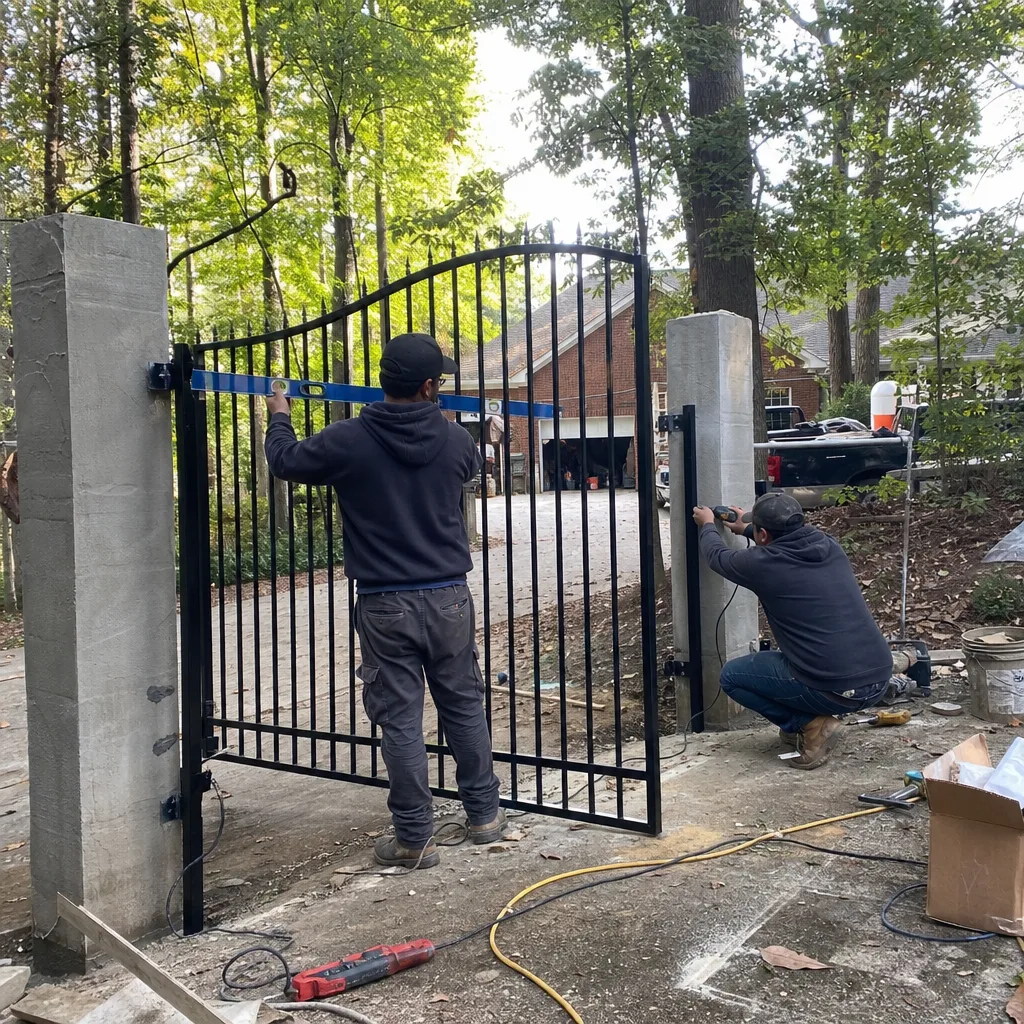
Here is a season-by-season calendar that aligns with actual Roswell weather patterns and the specific failure modes we have documented across 22,000+ gates since 2014.
March: Spring Rust Inspection
- Inspect five weld points: hinge barrels, picket-to-rail, frame gussets, operator bracket, post caps
- Check drainage around post footings after winter saturation
- Test operator function after winter dormancy; limit switches may need reset
- Document with photos; compare to prior spring
June: Summer Heat Preparation
- Clear vegetation 18 inches from operator enclosure
- Inspect ventilation slots for obstruction
- Schedule technician for capacitor testing and board inspection if gate is over 5 years old
- Check remote battery strength; heat degrades battery performance too
September: Fall Photo-Eye Service
- Clean and realign photo-eyes before peak pollen ends
- Check LED status and record colors
- Inspect gate path for new obstructions: fallen branches, grown shrubs, installed landscape lighting
- Test manual release mechanism; winter ice may require its use
December: Winter Post Assessment
- Check post plumb after first freeze-thaw cycle
- Inspect concrete collars for new cracks
- Verify gate gap consistency
- Check operator arm for binding at travel limits
- Document; compare to prior December
This calendar assumes a typical Roswell residential swing or slide gate with electric operator. Gates with Gate Motor & Opener in Roswell configurations from Viking or DoorKing, common in the larger estate properties north of the city, may need additional checks for battery backup systems before winter storm season.
Common Mistakes to Avoid
- Using a pressure washer on the operator enclosure. The force drives water past gaskets into the control board compartment. We replace multiple boards each year in Roswell after this exact mistake, usually following a spring cleaning binge.
- Adjusting limit switches without measuring travel first. The limit switch tells the operator when the gate is fully open or closed. Moving it to “fix” a binding gate masks the real problem, usually post movement, and overworks the motor until it fails.
- Ignoring three-beep or five-beep diagnostic codes. Most operators flash lights or beep in patterns that indicate specific faults. Homeowners who reset the operator without recording the code lose the diagnostic information a technician needs.
- Applying automotive grease to gate hinges. Automotive grease attracts dirt and hardens in outdoor conditions. Use a lithium-based gate hinge grease, or call for proper lubrication as part of seasonal service.
- Planting shrubs against gate posts for aesthetics. The root ball displaces soil, alters drainage, and the mature plant holds moisture against the footing. Maintain 12 inches of clear space minimum.
- Assuming a gate that “just started acting up” has a simple fix. In our Roswell experience, sudden behavior changes usually trace to progressive problems that reached a threshold. The fix is rarely the obvious one.
When to Call a Professional
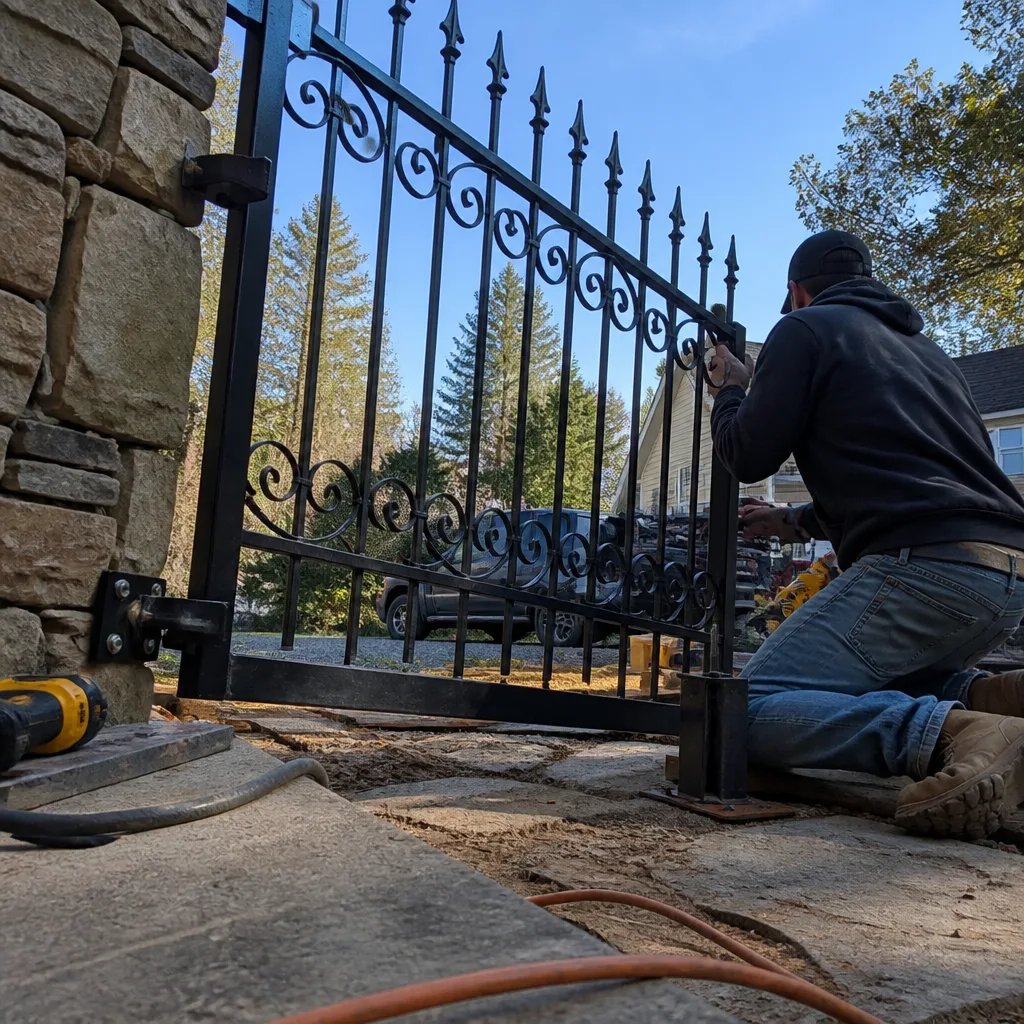
Some seasonal maintenance is within a careful homeowner’s ability. Some is not, and the boundary is not always obvious. Read our DIY vs Professional Gate Repair: The Roswell Homeowner’s Decision Guide to help decide. Call a technician when you encounter any of the following: post movement of any degree; rust that has pitted or perforated the metal; electrical work inside the operator enclosure; capacitor testing or replacement; welding repair; or any situation where the gate’s behavior changed suddenly after a weather event.
These scenarios involve either structural safety (a tilting post can drop a gate), electrical hazard (capacitors store lethal charge even with power disconnected), or specialized equipment (proper weld repair requires a 220V MIG or stick welder and the skill to use it without distorting the gate frame).
Gate Repair services from Vance Gate Repair Roswell include free estimates in Roswell. We will review your seasonal documentation, inspect the gate, and provide a written price before any work begins under Haven Standard Clause 1. If you have a written estimate from another company, we provide a free second opinion, bring that paperwork. Call (706) 928-9815. A live person answers, 24 hours a day.
Frequently Asked Questions
A professional seasonal inspection and tune-up for a residential gate in Roswell typically runs between $150 and $280, depending on the gate type and whether minor adjustments or component replacements are needed during the visit. This includes the documented photo record, written findings, and any limit switch or photo-eye adjustments. If welding repair or capacitor replacement is required, we quote that separately in writing before proceeding. Call (706) 928-9815 for an exact quote, estimates are free.
Homeowners can handle visual inspections, photo-eye cleaning, vegetation clearance, and documentation photography safely. Capacitor testing, electrical work inside the operator enclosure, welding, and post stabilization require training and equipment. We recommend establishing the documentation habit yourself and scheduling a professional inspection annually to catch what visual checks miss.
At minimum, once per year, ideally in September before fall pollen and winter freeze-thaw stress. Gates over 8 years old, or those with prior capacitor or board issues, benefit from semi-annual inspection. The 22,000+ gates in our records show that Roswell’s combination of summer heat and winter soil movement accelerates wear compared to more temperate climates.
Photo-eye misalignment or obstruction is the cause in roughly 70% of cases we diagnose. The remaining 30% splits between limit switch drift, mechanical binding from post movement, and operator board faults. The “no apparent reason” framing usually means the photo-eye LED indicators were not checked. We always verify LED status first; it takes 30 seconds and prevents unnecessary component replacement.
We service nine major automation brands: LiftMaster, FAAC, BFT, Linear, Viking, Ghost Controls, DoorKing, Elite, and Mighty Mule. Our default is repair, not replacement, and we stock common components for all nine brands. Replacement is recommended only when the operator is beyond economical repair, typically after 15+ years or when the manufacturer has discontinued parts support. The written quote specifies both repair and replacement options when both exist.
The Haven Standard is our documented work protocol: written price before any work starts (Clause 1), photographic evidence of what was found and what was done (Clause 4), and the 365-Day Done Right Promise covering all completed work. It applies to every visit, including seasonal maintenance inspections. You receive the photo record and written findings even if no repair is needed during that visit.
The Bottom Line
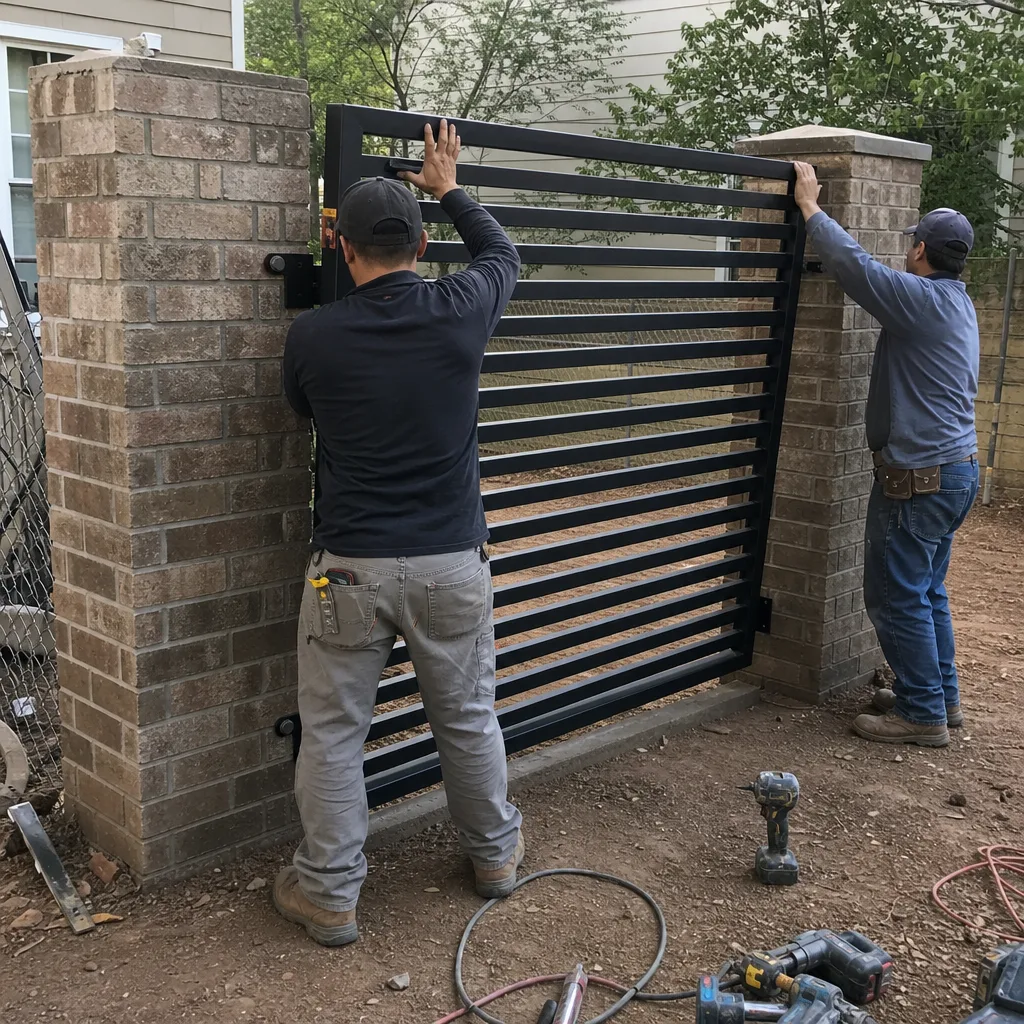
Roswell’s four seasons each stress a different part of your gate system. Summer heat attacks capacitors and boards. Fall pollen blinds photo-eyes. Winter freeze-thaw shifts post footings. Spring humidity accelerates rust at weld points. A generic “quarterly check” misses these specific mechanisms. The homeowners who avoid emergency repairs are the ones who match the inspection to the season, document what they find, and compare year over year to spot trends. Start with the calendar in this guide, establish your photo record, and schedule professional inspection when the problem exceeds your tools or training. Explore our more guides & resources for year-round gate care. The cost of prevention is always lower than the cost of a gate that fails when you need it to open.
Written by Adrian Vance, Owner at Vance Gate Repair Roswell, serving Roswell since 2014.